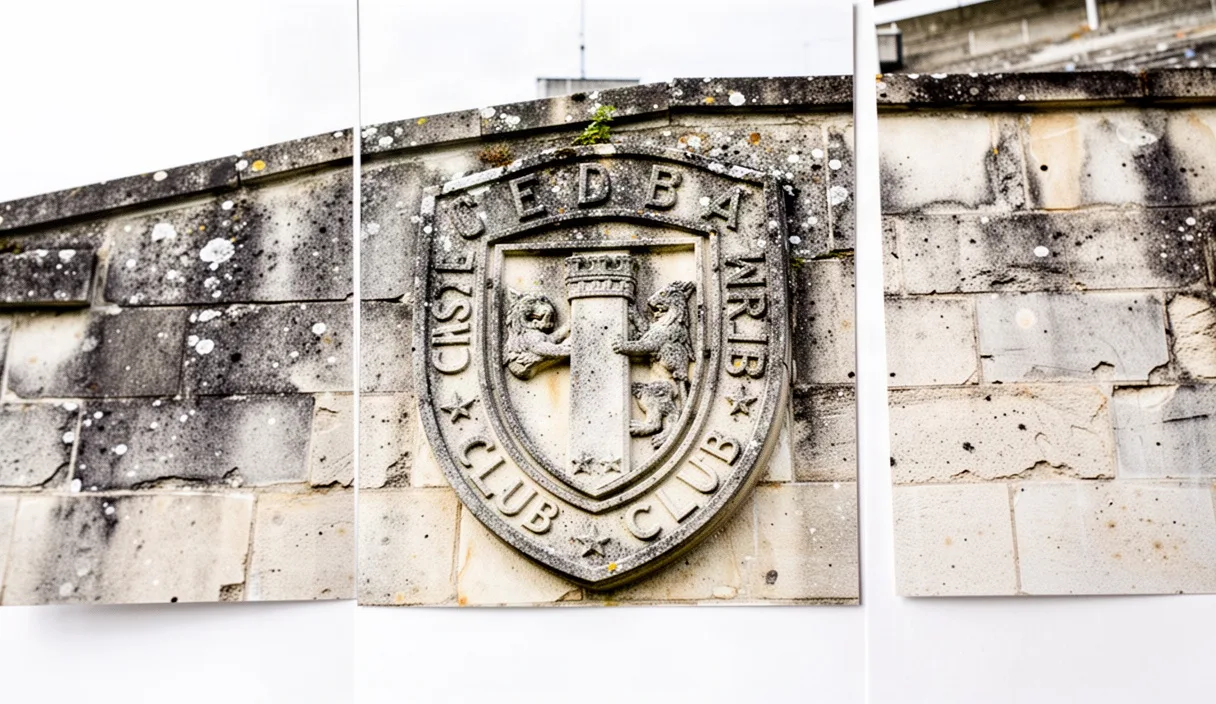
A club badge sits on a shirt for ninety minutes, but it carries decades of local history in a few square centimeters. Look closely at any crest and you find a factory, a river, a saint, a animal, a color that meant something before football existed.
This article looks at what badges show, what they hide, and how to read them like a small historical document. No badge tells the whole story of a city. But most of them tell more than fans realize.
What symbols commonly appear on club badges
Most badges draw from a short list of recurring symbols. Animals appear often: lions, eagles, bulls, wolves. These come from heraldry, from royal or noble families who once controlled the land where the club formed.
Religious symbols show up too. Crosses, saints, and church towers point to a city's patron saint or founding religious order. AC Milan's badge carries the red cross of Saint George, tied to the city's medieval history, not to the club itself.
Civic symbols are common as well. A castle, a bridge, a ship, a tower. These usually copy the city's own coat of arms, sometimes exactly, sometimes simplified. The badge borrows the city's authority and puts it on a shirt.
- Animals: lions, eagles, horses, bulls, wolves
- Religious marks: crosses, saints, halos, church towers
- Civic marks: castles, bridges, ships, city walls
- Natural features: rivers, mountains, stars, suns
- Tools and objects: anchors, hammers, shields, wheels
None of these symbols were invented for football. Clubs borrowed them because they already meant something to the people watching.
Industry and geography in crest design
Many badges show what the city made, not just where it sat. Sheffield United's badge once referenced the city's steel and cutlery trade. Sunderland's crest carries a ship, a direct nod to the shipbuilding industry that shaped the Wear.
Geography works the same way. Rivers appear on badges in port cities and river towns. Mountains appear where the club sits near a range, as with several Alpine clubs in Austria and northern Italy. A badge with a wheat sheaf usually points to farmland, not factories.
This matters because industry often decided who played for the club in the first place. Early football clubs formed inside factories, railway yards, and mines. West Ham United began as Thames Ironworks, and the badge still carries crossed hammers, a direct reference to the ironworkers who founded the team in 1895.
| Club | City industry | Badge reference |
|---|---|---|
| West Ham United | Iron and shipbuilding | Crossed hammers |
| Sunderland | Shipbuilding | Ship on the crest |
| Sheffield United | Steel manufacturing | Historic steel-related motifs |
| Schalke 04 | Coal mining | Mining heritage in club identity |
A badge like this works as a small labor record. It tells you what the men who built the club did for a living before they played football on Saturdays.
How redesigns reflect a club's changing identity
Badges change more often than fans expect. A club rarely redesigns for design's sake alone. Usually something outside football pushes the change: a merger, a sponsor, a change in ownership, a shift in how the club wants to be seen.
Juventus removed most of its historic imagery in 2017 and moved to a flat, minimal "J" mark. The club explained this as a shift toward a global sports brand, not just a football team. Fans who valued the older crest saw this as a loss of local texture.
Leeds United tried a similar move in 2018 with a stripped-down badge. The backlash was immediate and loud. Leeds reversed the decision within days, a rare case where fan pressure directly overturned a design choice.
Redesigns tend to follow a few patterns:
- Simplification for merchandise and digital use
- Removal of religious or political symbols under new ownership
- Addition of stars or crowns to mark championships won
- Return to older, "classic" versions after fan protest
Each redesign is a small vote on what the club values: heritage, marketing reach, or fan sentiment. The badge history of a club often reads like a timeline of who held power at each point.
Reading color choices historically
Color on a badge rarely happens by accident, though the original reason is often lost within a generation or two. Some clubs chose colors tied to local aristocracy. Others picked whatever fabric was cheap and available when the club needed its first kit.
Barcelona's blue and red are commonly linked to founder Joan Gamper's other club in Switzerland, not to Catalonia itself. This surprises many fans who assume every color choice carries deep regional meaning.
Other cases are more directly local. Athletic Bilbao's red and white stripes are tied to the Basque region's industrial identity and to early British influence on the club's founding. AS Roma's maroon and gold reference ancient Rome's imperial colors, a direct link between the club and the city's pre-football history.
A short list of common color origins:
- Colors copied from a sister club or founder's home team
- Colors tied to a local noble family or historic flag
- Colors chosen for cheap, available fabric in the founding years
- Colors adopted later to match a new sponsor or owner
Color history is harder to verify than symbol history. Written club records from the 1880s and 1890s are thin, so many color stories rely on oral tradition passed through supporters' clubs, not official archives. Treat some of these stories as likely, not certain.
Three badges with clear local stories
Some badges carry a story that is well documented and easy to trace. These three are useful starting points for anyone learning to read crests.
Newcastle United. The badge shows two seahorses flanking a shield, with local symbols tied to the city of Newcastle upon Tyne, including a reference to the river and the region's coal history. The seahorses came from the city's own coat of arms, not from football tradition.
Borussia Dortmund. The badge carries the city's colors, yellow and black, tied to the Westphalia region's industrial past. The name "Borussia" is a Latin form of Prussia, a direct link to the region's 19th-century political identity before Germany unified in 1871.
Celtic. The badge and colors connect to the club's founding in 1888 by Irish immigrants in Glasgow's East End. The four-leaf clover and green color point directly to Ireland, not to Scotland, making Celtic one of the clearest cases of a badge documenting migration rather than local geography.
These three badges work well as teaching examples because each element has a documented origin. Many clubs have less clear records, especially those founded before 1900, when few organizations kept detailed written archives of design decisions.
What a badge cannot tell you
A badge shows chosen symbols, not full history. It cannot tell you about the people left out of the club's early membership, often based on class, religion, or race in the 1800s and early 1900s.
A badge cannot tell you about financial struggles, ownership disputes, or years when the club nearly folded. Reading crest design alone gives a partial, curated version of a city's story, shaped by whoever had design authority at each point in the club's history.
For a fuller picture, pair badge history with other sources: local newspaper archives, club membership records where available, and academic writing on football and regional identity. A local historian or university sports history department can often point toward primary sources a casual search will not surface.
Common mistakes
Fans and casual researchers repeat a few errors when reading badge history.
- Assuming every color has a deep symbolic meaning, when some choices were practical or accidental.
- Treating fan folklore as verified fact without checking club or municipal archives.
- Ignoring redesign dates, which often reveal more about ownership changes than about the city itself.
- Comparing badges across countries without accounting for different heraldic traditions.
Next steps for readers
Start with your own club, if you have one. Find the founding year, then look for local coat-of-arms records from that period.
Compare the club's current badge with any earlier versions, usually available through official club history pages or football museum archives. Note every date a redesign happened.
Cross-check any color or symbol story with at least one written source beyond forum posts or fan wikis. If the club has a museum or archive, contact them directly with specific questions.
Treat badge history as one layer of a city's story, not the whole picture. The full history usually needs a library, not just a shirt.