
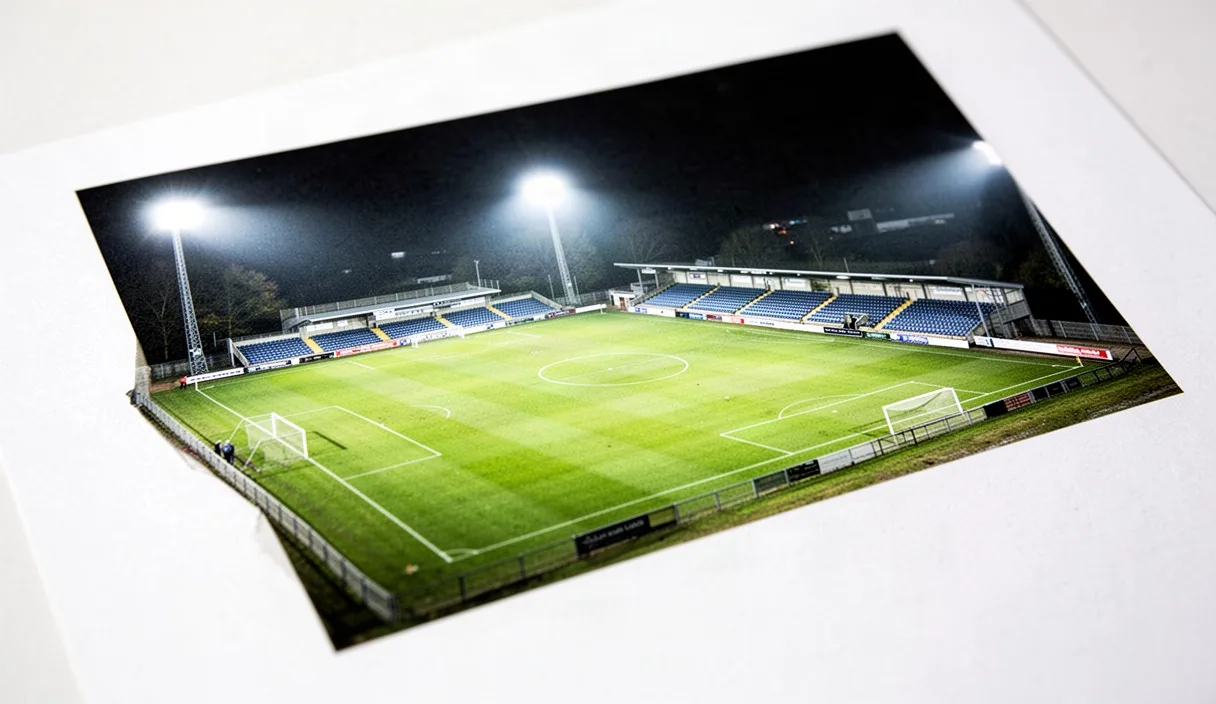
A lower-league club rarely has a broadcast deal. There is no highlights package on national television, no guaranteed match commentary in English, no app that pushes score alerts to your phone the second a goal goes in. Following a club like this from another country means building your own system, piece by piece.
This guide walks through that system. It covers streaming, local press, supporter communities, fixture tracking across smaller competitions, and how to stay informed without daily coverage from national outlets. None of it requires special access. It requires patience and a routine.
Why lower-league coverage differs from top-flight coverage
A top-flight match is covered by wire services, national broadcasters, and dozens of accredited journalists in the press box. A lower-league match might have one local reporter, a club-run Twitter account, and nothing else. The information exists. It is just harder to find and slower to arrive.
Top-flight clubs often stream or broadcast every match somewhere in the world. Lower-league clubs may stream only home games, or only games not selected for a regional TV slot, or none at all if the ground lacks the equipment. Rights are also more fragmented. A league one division down from the top flight might sell streaming rights separately for its television package, its radio commentary, and its written matchday coverage.
Delays are common too. A national paper posts a match report on a Premier League game within minutes of the final whistle. A local paper covering a fourth-tier club might post the same report the next morning, after the reporter has filed other work first. None of this means the information is unreliable. It means the timeline is different, and a fan following from abroad has to adjust expectations rather than wait for something that will not come.
Finding official club streaming options
Start with the club's own website before searching anywhere else. Most lower-league clubs list their streaming partner on the fixtures or "how to watch" page. In England, this is often a league-wide platform tied to the division, such as a paid match pass system covering League One, League Two, or the National League. In other countries, the federation or league body usually runs something similar.
Check three things before paying for any streaming pass:
- Whether the pass covers the specific match, since some fixtures are blacked out for broadcast reasons.
- Whether the pass works with your country's IP address, since geo-restrictions sometimes apply even to lower-tier football.
- Whether the stream is live or delayed, since some clubs only offer replays after the match ends.
Radio commentary is often a cheaper and more reliable alternative. Many lower-league clubs partner with a local radio station, and that station streams commentary online for a small fee or for free. The audio quality is not always polished. The commentary still gives a real-time sense of the match that a delayed text feed cannot.
If no stream exists for a fixture, check the opposing club's website. One side of a match sometimes streams when the other does not, particularly for away supporters who cannot travel.
Using local press for consistent updates
A local newspaper, print or online, is usually the most consistent source of coverage for a lower-league club. The reporter who covers the club likely attends every home game and most away games, and often has relationships with the manager and players that produce quotes national coverage never picks up.
Search for the newspaper serving the club's home town, not just the club's own name. A club called "Town" or "United" produces search results dominated by bigger clubs with similar names. Searching "[town name] football club news" narrows results faster than searching the club's official name alone.
Once you find the right outlet, look for these signs of a reliable beat reporter:
- Match reports published within a day of the game, not just occasional features.
- Direct quotes from the manager after matches, suggesting press access.
- A regular byline, meaning one person tracks the club consistently rather than rotating reporters with less context.
Many local papers now offer email newsletters or RSS feeds specific to one club. Subscribing removes the need to check the site manually. It also means updates arrive even on weeks when you are not actively following along.
Joining supporter communities online
Fan forums and supporter group chats often carry information faster than any official source. A supporter sitting in the ground can post a lineup, a substitution, or an injury update before the club's own social accounts do.
Look for a dedicated forum tied to the club, not a general league-wide board. General boards move too fast and bury club-specific detail. A dedicated forum, even a small one with a few hundred active users, tends to hold institutional knowledge: ticket processes, travel routes, historical context on rivalries, and informed opinion on team form.
Messaging platforms have largely supplemented, and in some cases replaced, older forums. A club-specific group on a messaging app can produce near-live updates during a match, posted by supporters physically present.
A short comparison of common supporter community formats:
| Format | Speed of updates | Depth of context |
|---|---|---|
| Dedicated club forum | Moderate | High |
| Messaging app group | High | Low to moderate |
| General league-wide board | High | Low |
| Official club social accounts | Moderate to low | Low |
Treat supporter reports as useful but unverified until confirmed elsewhere. A fan's live post about an injury is often accurate. It is not the same as a club statement or a reporter's confirmed account, and the two should not be weighted equally when a decision or a strong opinion depends on the detail.
Tracking fixtures across smaller competitions
A lower-league club plays in more than one competition most seasons: the league itself, a domestic cup, sometimes a regional trophy or a lower-tier continental competition. Each of these can run on a separate schedule, published by a separate body, and updated on a separate site.
Build a single fixture list rather than checking multiple sources every week. A basic method works well:
- Find the club's official fixture page and copy every known date into one calendar.
- Add a note for any fixture still marked "TBC," since lower-league cup rounds often get scheduled only a week or two ahead.
- Recheck that calendar weekly, since cup replays and rearranged league games shift dates more often than at the top level.
- Set a reminder two days before each match to confirm kickoff time, since lower-league kickoffs can move for policing or broadcast reasons with little notice.
Time zone conversion deserves its own check. A 3:00pm kickoff on a Saturday in England is not the same clock time everywhere, and daylight saving changes in either country can shift the gap by an hour at certain points in the year. Confirm the converted time close to the match date rather than trusting a conversion made months earlier.
Smaller competitions also change format more often than top-flight leagues. A regional trophy might switch from two-legged ties to single matches, or expand its entry list, from one season to the next. Reading the competition's own rules page at the start of each season avoids confusion later.
Staying updated without daily national coverage
National football coverage, in most countries, focuses on a handful of top-flight clubs and the national team. A lower-league club will not appear in that coverage on a normal week, even after a strong result. This is not a signal that something has gone wrong. It is simply the normal state of coverage at that level.
A weekly routine works better than checking constantly for coverage that will not appear:
- Check the club's own site and social accounts once after each match for the official version of events.
- Check the local paper the following morning for the match report and manager quotes.
- Check the league table once a week, since lower-league standings can shift with midweek fixtures that are easy to miss.
- Check supporter forums for any news the club has not yet confirmed publicly, such as a manager departure or a takeover rumor.
Set expectations around silence. A week with no news from a lower-league club usually means nothing has happened worth reporting, not that information has been withheld. Comparing that silence to the constant coverage of a top-flight club leads to unnecessary worry about missing something.
Common mistakes
Relying on a single source is the most common mistake. A club's own social accounts will not report bad news the same way an independent local paper will, and a local paper will not carry the same real-time detail as a supporter posting from the stand.
Assuming geo-restrictions do not apply to smaller leagues is another mistake. Streaming rights are sold regionally even for lower-tier football, and a pass that works for a friend in one country can fail entirely in another.
Treating supporter forum posts as confirmed fact, without checking an official source, causes avoidable confusion, particularly around injuries, transfers, or managerial changes.
Ignoring cup and trophy fixtures because they are not part of the main league table leads to missed matches, since these games often affect squad rotation and form even when the competition itself carries less weight.
Next steps
Pick one club and build the routine described above around that club specifically. Start with the official site, add the local paper, then add one supporter community. Build the fixture calendar once, and revisit it weekly rather than daily.
If a streaming or ticketing question involves a payment dispute or a subscription that will not cancel, contact the platform's support team directly rather than relying on forum advice. Support processes vary by provider and region, and a forum post cannot resolve a billing issue on your behalf.
Coverage of a lower-league club will always move slower than coverage of a top-flight one. A routine built around that pace, rather than against it, is what makes following the club from abroad sustainable over a full season.